Is Cato a VPN? How Cato Networks Connects and Protects Users
Cato is not just a VPN. It combines remote access with cloud-based networking and security in a SASE platform.
How Cato connects and protects remote users
| Area | Cato Networks | Traditional VPN | Consumer VPN |
|---|---|---|---|
| Main purpose | Business network access and security | Remote access to an organization’s network | Privacy and internet-location services |
| Typical users | Employees and other authorized users | Employees and other authorized users | Individual consumers |
| Connection destination | Organization resources through Cato’s network | Organization’s private network | Consumer VPN provider’s servers |
| Access control | Organization-managed policies | Organization-managed access | Provider’s service and account controls |
| Security approach | Cloud-delivered networking and security | VPN tunnel, often alongside other security tools | Encrypted connection to the provider |
| Internet traffic | Can be governed by organizational policies | Often routed through the organization | Routed through the provider |
| Infrastructure | Cato’s cloud-based service | Organization-managed VPN infrastructure | Consumer VPN provider’s infrastructure |
| Best fit | Organizations seeking managed connectivity and security | Organizations needing conventional remote network access | Individuals seeking consumer VPN features |
Compiled November 2026; check the provider's site for current details.
| VPN | Obfuscation | From / month | Plan | Free plan | Refund | Alipay | UnionPay | Crypto | Website opens in China | Trustpilot | |
|---|---|---|---|---|---|---|---|---|---|---|---|
 ZoogVPN | Turn on manually Shadow | $2.49/mo | 27 months: $59.99 | Yes | 7 days | ✓ | ✓ | ✓ | ✓ | Official site blocked; our special link opens (4.4 s) | 4.2/5 (195 reviews) |
 NordVPN | Turn on manually Obfuscated Servers / NordWhisper | $3.49/mo | 27 months: $94.23 | No | 30 days | ? | ✗ | ✓ | ✓ | ✗ Blocked | 4.2/5 (51,628 reviews) |
 ExpressVPN | ✓ On by default all servers | $3.00/mo | 28 months: $84 | No | 30 days | ✗ | ✗ | ✓ | ✗ | ✗ Blocked | 4.4/5 (29,706 reviews) |
 Surfshark | ✓ On by default Camouflage, with OpenVPN | See site | See site | No | 30 days | ✗ | ✗ | ✗ | ✓ | ✗ Blocked | 4.3/5 (31,823 reviews) |
 Proton VPN | Turn on manually Stealth, free plan too | $2.99/mo | 12 months: $35.88 | Yes | 30 days | ✗ | ✗ | ✗ | ✓ | ✗ Blocked | 2.1/5 (1,040 reviews) |
 Astrill VPN | Turn on manually StealthVPN / OpenWeb | $12.50/mo | 24 months: $300 | No | See site | ✗ | ✗ | ✗ | ✓ | ✗ Blocked | 1.3/5 (110 reviews) |
 Private Internet Access | Turn on manually Shadowsocks, OpenVPN only | $2.03/mo | 40 months: $81.2 | No | 30 days | ✗ | ✗ | ✗ | ✗ | ✗ Blocked | 4.2/5 (11,033 reviews) |
 CyberGhost | Turn on manually selected servers | $2.19/mo | 28 months: $61.32 | No | 45 days | ✗ | ✗ | ✗ | ✓ | ✗ Blocked | 4.0/5 (24,178 reviews) |
 PureVPN | Turn on manually switch to OpenVPN | $1.69/mo | 60 months: $101.55 | No | 31 days | ? | ? | ✗ | ✓ | ✗ Blocked | 4.4/5 (17,994 reviews) |
 AdGuard VPN | ✓ On by default TrustTunnel | $2.99/mo | 24 months: $71.76 | Yes | 30 days | ✓ | ✗ | ✓ | ✓ | Official site blocked; our special link opens (3.7 s) | 4.3/5 (290 reviews) |
 Mullvad | Turn on manually QUIC / Shadowsocks / LWO | $5.61/mo | €5/mo | No | 14 days | ✗ | ✗ | ✗ | ✓ | ✗ Blocked | 3.2/5 (192 reviews) |
 Windscribe | Turn on manually Stealth / WStunnel | $5.75/mo | 12 months: $69 | Yes | See site | ✗ | ✗ | ✗ | ✓ | ✗ Blocked | 4.7/5 (13,355 reviews) |
 StrongVPN | Turn on manually Scramble, OpenVPN TCP | See site | See site | No | 30 days | ✓ | ✗ | ✗ | ✗ | ✗ Blocked | 4.4/5 (2,695 reviews) |
 LightXtreme 闪连 | Not listed | $7.08/mo | 12 months: $84.99 | Yes | 30 days | ✓ | ✓ | ✓ | ✓ | ✓ Yes (3.5 s) | No page |
Prices checked 2026-11-10 on each vendor's pricing page (cheapest long plan, USD). Check the vendor's checkout for the final price.
Obfuscation checked 2026-11-14 on each vendor's site and help center: "on by default" = nothing to set; "turn on manually" = switch protocol or mode in settings; "not listed" = the vendor describes no obfuscation.
Payment methods checked 2026-11-10 on each vendor's payment pages: all 14 take cards and PayPal; ✗ = not listed, ? = the vendor's own pages disagree.
China access: whether the official website opens from mainland China networks (tests the website only, not the VPN connection). Last checked 2026-11-18 01:02 Beijing time.
Trustpilot score and review count checked 2026-11-10.
Is Cato a VPN?
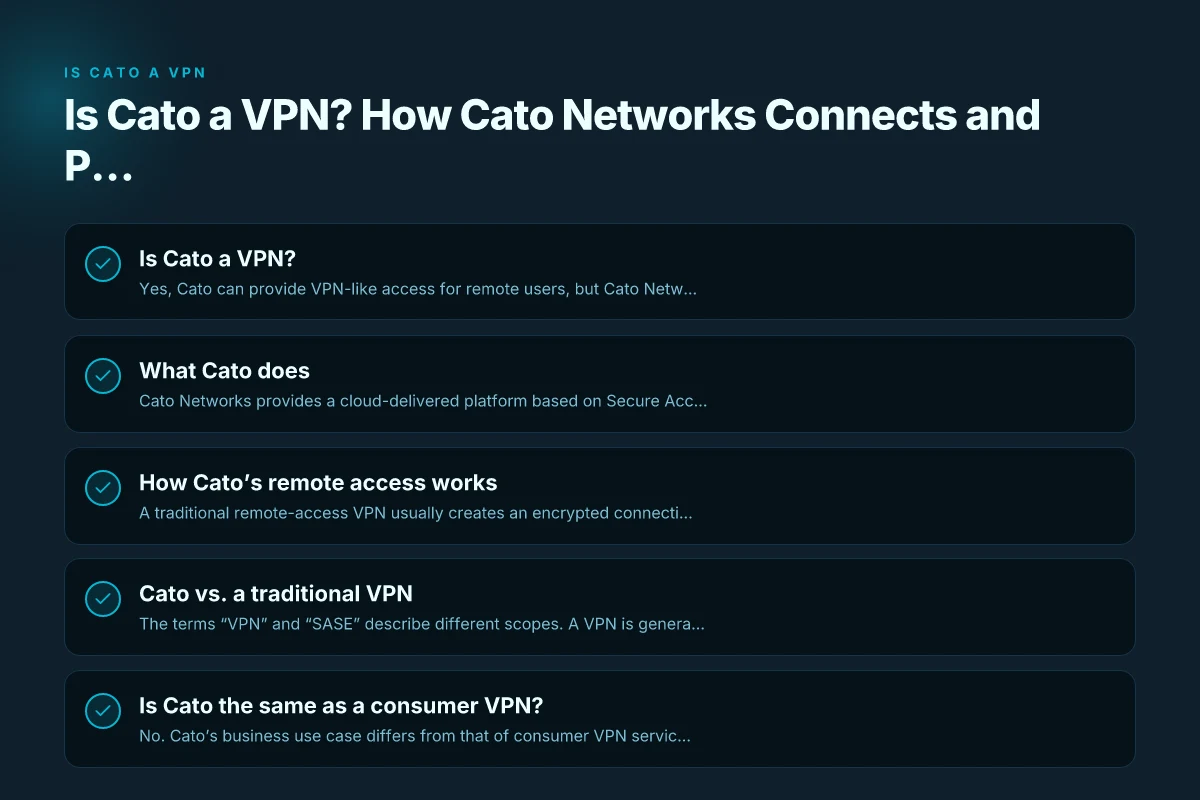
Yes, Cato can provide VPN-like access for remote users, but Cato Networks is not simply a traditional VPN provider. Its main offering is the Cato SASE Cloud Platform, which combines networking and security services delivered through a global cloud network.
Organizations use Cato to connect employees, offices, cloud environments, and applications. Remote workers can use the Cato Client to connect to their organization’s network and access approved resources. That connection may feel similar to using a VPN, but it is part of a wider system for managing network access and security.
In short, Cato can replace or supplement a conventional VPN, but calling the entire platform “a VPN” leaves out much of what it does.
What Cato does
Cato Networks provides a cloud-delivered platform based on Secure Access Service Edge, or SASE. SASE combines network connectivity with security controls, rather than treating them as separate systems that an organization must assemble and maintain independently. Free Clash: How to Play Clash Games for Free
Depending on an organization’s configuration and licensing, Cato’s platform can bring together capabilities such as:
- Remote access for employees
- Connectivity between offices and data centers
- Access to cloud services and applications
- Security inspection and policy enforcement
- Centralized management and network visibility
The Cato Cloud is the backbone for connecting users and locations. Traffic can be routed through this cloud network, where an organization’s policies and security protections are applied.
The specific features available depend on the services an organization has purchased and how its administrators have configured them. A user’s experience may therefore differ from one company to another.
How Cato’s remote access works
A traditional remote-access VPN usually creates an encrypted connection between a user’s device and a corporate network or VPN gateway. This lets the user reach internal resources as if they were connected at an office, subject to company policies. Proton VPN Extension for Edge: How to Install and Use It
Cato’s remote access serves a similar purpose. An employee typically installs the Cato Client, signs in using the organization’s authentication process, and connects to the company’s Cato environment. Administrators can set rules governing who can connect and what resources they can access.
The important distinction is that Cato’s connection is designed to work within the larger Cato SASE platform. Instead of just providing a tunnel to a corporate network, the platform can also apply centrally managed security and networking policies as traffic moves between users, locations, and applications.
That does not mean every Cato setup automatically provides every security feature. The protections users receive depend on the organization’s configuration, subscriptions, and policies.
Cato vs. a traditional VPN
The terms “VPN” and “SASE” describe different scopes. A VPN is generally a way to create a protected network connection. SASE describes a broader approach that combines connectivity and security services. How to Fix Virgin TV Go App Not Working With VPN
| Capability | Traditional remote-access VPN | Cato SASE platform |
|---|---|---|
| Remote user connection | Typically provided through a VPN client and gateway | Available through the Cato Client and Cato Cloud |
| Main purpose | Create a protected connection to a private network | Connect users, sites, and resources with integrated security services |
| Network scope | Often centered on a corporate network or gateway | Designed to connect multiple locations, users, and cloud resources |
| Management | May involve separate network and security tools | Intended to provide centralized management for the Cato environment |
| Security features | Vary by VPN product and additional tools | Depend on the services purchased and the organization’s configuration |
This comparison is general. Traditional VPN products vary, and some include advanced security features. Likewise, Cato’s platform capabilities depend on the particular deployment. The practical difference is that Cato is positioned as a broader networking and security platform, not only as software for making VPN connections.
Cato versus a traditional business VPN
| Consideration | Cato Networks | Traditional VPN |
|---|---|---|
| Service model | Cloud-delivered platform | VPN service, often organization-operated |
| Remote connection | Connects users to organizational resources | Connects users to the organization’s network |
| Security scope | Networking and security capabilities | VPN connectivity; other protections may be separate |
| Policy management | Managed through organizational policies | Managed through VPN and related systems |
| Traffic handling | Can apply organizational policies to traffic | Depends on configuration and network design |
| Infrastructure responsibility | Cato provides its cloud service | Organization typically manages or procures VPN infrastructure |
| Operational fit | Suits organizations adopting cloud-delivered networking | Suits organizations using conventional VPN architecture |
| Key limitation | Depends on Cato service and organizational setup | May require separate tools and infrastructure management |
Compiled November 2026; check the provider's site for current details.
Is Cato the same as a consumer VPN?
No. Cato’s business use case differs from that of consumer VPN services. BSNL VPN.ovpn File: What It Is and How to Get One Safely
A consumer VPN commonly routes an individual’s internet traffic through a provider’s servers. People may use one for privacy on public Wi-Fi, to change their apparent IP location, or to route traffic through a different region. A consumer service typically does not give a user authorized access to their employer’s private applications.
Cato is designed for organizations. A company’s administrators manage access, policies, and connections for its users and sites. Employees use the service to reach business resources under company rules. They are not simply purchasing an anonymous personal internet connection.
So if someone asks whether Cato is a VPN, the answer depends on what they mean. Cato offers VPN-like remote connectivity for business users, but it is not the same kind of service as a personal VPN subscription.
Benefits and limitations to consider
For a business, a SASE platform may help consolidate networking and security management. Connecting remote workers and offices through one cloud-delivered environment can also make policies easier to apply consistently. A unified management approach may be useful for organizations with distributed teams, multiple locations, or substantial cloud use. Total VPN on Fire Stick: How to Install and Use It
However, adopting Cato is not automatically the right choice for every organization. Before moving away from an existing VPN or networking setup, decision-makers should consider:
- Whether Cato supports the organization’s required applications and network design
- How its access and security policies will be configured
- What features are included in the proposed subscription
- How the service fits with identity systems and existing security tools
- The cost and effort involved in deployment, migration, and user support
- What happens if users experience connectivity problems or an outage
It is also important to distinguish a platform’s available features from the protections a company has actually enabled. Administrators should confirm the configuration and test access controls rather than assuming that installing a client alone provides complete security.
Which option fits your needs?
| Need | Cato Networks | Traditional VPN | Consumer VPN |
|---|---|---|---|
| Give employees access to company resources | Supported | Supported | Not designed for this |
| Apply organization-wide security policies | Supported through organizational controls | Possible, depending on setup | Limited to provider features |
| Connect to a company network remotely | Supported | Supported | Not its primary purpose |
| Protect personal browsing on public Wi-Fi | Depends on organizational setup | Depends on organizational setup | Common use |
| Choose an apparent internet location | Not its primary purpose | Not its primary purpose | Common use |
| Manage users as an organization | Supported | Supported | Not designed for enterprise access management |
| Replace all security tools automatically | No; depends on requirements | No; often needs additional tools | No; consumer service scope |
| Choose based on business network needs | Strong fit for cloud-delivered networking and security | Fit for conventional remote access | Generally not a business-access solution |
Compiled November 2026; check the provider's site for current details. Axgate VPN Client Download: Official Sources, Setup, and Troubleshooting
Recommendation
Cato is best described as a SASE platform that includes VPN-like remote access, not as just a VPN. It may suit organizations seeking to manage remote users, office connectivity, cloud access, and security through a unified service.
For an individual looking for a personal VPN, Cato is generally not the relevant kind of product. For a business evaluating remote-access options, compare Cato with both traditional VPN solutions and other SASE platforms, using your organization’s application, security, management, and budget requirements as the deciding factors.