IPsec VPN connection is down forticlient: Causes and Fixes
Fix a FortiClient IPsec VPN connection that is down with practical checks for credentials, network access, configuration, and logs.
If your ipsec vpn connection is down forticlient, first confirm that your device has internet access, the VPN gateway is reachable, and your credentials are valid. Then check FortiClient’s connection settings and status. A VPN can fail because of a local network issue, an expired password or certificate, an incorrect IPsec configuration, or a problem with the VPN gateway. Work through the checks below in order, and contact your organization’s VPN administrator if the issue appears server-side.
Quick checks for a FortiClient IPsec VPN connection that is down
| Check | What to verify | If it is wrong | If it looks correct | When to escalate |
|---|---|---|---|---|
| Internet connection | Other websites or services load | Restore internet access first | Continue to FortiClient checks | If connectivity remains unavailable |
| FortiClient status | VPN client is running and shows its current state | Reopen or restart the client | Check connection settings | If the client will not start |
| VPN gateway | Server address matches the administrator’s details | Correct the gateway address | Check credentials | If the correct address still fails |
| Credentials | Username and password are current | Enter the correct credentials | Check authentication requirements | If credentials are rejected |
| Authentication | Required authentication method is configured | Update the method as instructed | Review IPsec settings | If the method is unclear |
| IPsec settings | Client settings match the required configuration | Correct mismatched settings | Check network restrictions | If settings are administrator-managed |
| Network restrictions | The current network allows the VPN connection | Try an allowed network if available | Review logs and device conflicts | If restrictions need network changes |
| Device conflicts | Other VPNs or security tools may interfere | Temporarily rule out conflicts where permitted | Check connection logs | If changes require IT approval |
Compiled November 2026; check the provider's site for current details.
| VPN | Obfuscation | From / month | Plan | Free plan | Refund | Alipay | UnionPay | Crypto | Website opens in China | Trustpilot | |
|---|---|---|---|---|---|---|---|---|---|---|---|
 ZoogVPN | Turn on manually Shadow | $2.49/mo | 27 months: $59.99 | Yes | 7 days | ✓ | ✓ | ✓ | ✓ | Official site blocked; our special link opens (4.4 s) | 4.2/5 (195 reviews) |
 NordVPN | Turn on manually Obfuscated Servers / NordWhisper | $3.49/mo | 27 months: $94.23 | No | 30 days | ? | ✗ | ✓ | ✓ | ✗ Blocked | 4.2/5 (51,628 reviews) |
 ExpressVPN | ✓ On by default all servers | $3.00/mo | 28 months: $84 | No | 30 days | ✗ | ✗ | ✓ | ✗ | ✗ Blocked | 4.4/5 (29,706 reviews) |
 Surfshark | ✓ On by default Camouflage, with OpenVPN | See site | See site | No | 30 days | ✗ | ✗ | ✗ | ✓ | ✗ Blocked | 4.3/5 (31,823 reviews) |
 Proton VPN | Turn on manually Stealth, free plan too | $2.99/mo | 12 months: $35.88 | Yes | 30 days | ✗ | ✗ | ✗ | ✓ | ✗ Blocked | 2.1/5 (1,040 reviews) |
 Astrill VPN | Turn on manually StealthVPN / OpenWeb | $12.50/mo | 24 months: $300 | No | See site | ✗ | ✗ | ✗ | ✓ | ✗ Blocked | 1.3/5 (110 reviews) |
 Private Internet Access | Turn on manually Shadowsocks, OpenVPN only | $2.03/mo | 40 months: $81.2 | No | 30 days | ✗ | ✗ | ✗ | ✗ | ✗ Blocked | 4.2/5 (11,033 reviews) |
 CyberGhost | Turn on manually selected servers | $2.19/mo | 28 months: $61.32 | No | 45 days | ✗ | ✗ | ✗ | ✓ | ✗ Blocked | 4.0/5 (24,178 reviews) |
 PureVPN | Turn on manually switch to OpenVPN | $1.69/mo | 60 months: $101.55 | No | 31 days | ? | ? | ✗ | ✓ | ✗ Blocked | 4.4/5 (17,994 reviews) |
 AdGuard VPN | ✓ On by default TrustTunnel | $2.99/mo | 24 months: $71.76 | Yes | 30 days | ✓ | ✗ | ✓ | ✓ | Official site blocked; our special link opens (3.7 s) | 4.3/5 (290 reviews) |
 Mullvad | Turn on manually QUIC / Shadowsocks / LWO | $5.61/mo | €5/mo | No | 14 days | ✗ | ✗ | ✗ | ✓ | ✗ Blocked | 3.2/5 (192 reviews) |
 Windscribe | Turn on manually Stealth / WStunnel | $5.75/mo | 12 months: $69 | Yes | See site | ✗ | ✗ | ✗ | ✓ | ✗ Blocked | 4.7/5 (13,355 reviews) |
 StrongVPN | Turn on manually Scramble, OpenVPN TCP | See site | See site | No | 30 days | ✓ | ✗ | ✗ | ✗ | ✗ Blocked | 4.4/5 (2,695 reviews) |
 LightXtreme 闪连 | Not listed | $7.08/mo | 12 months: $84.99 | Yes | 30 days | ✓ | ✓ | ✓ | ✓ | ✓ Yes (3.5 s) | No page |
Prices checked 2026-11-10 on each vendor's pricing page (cheapest long plan, USD). Check the vendor's checkout for the final price.
Obfuscation checked 2026-11-14 on each vendor's site and help center: "on by default" = nothing to set; "turn on manually" = switch protocol or mode in settings; "not listed" = the vendor describes no obfuscation.
Payment methods checked 2026-11-10 on each vendor's payment pages: all 14 take cards and PayPal; ✗ = not listed, ? = the vendor's own pages disagree.
China access: whether the official website opens from mainland China networks (tests the website only, not the VPN connection). Last checked 2026-11-18 01:02 Beijing time.
Trustpilot score and review count checked 2026-11-10.
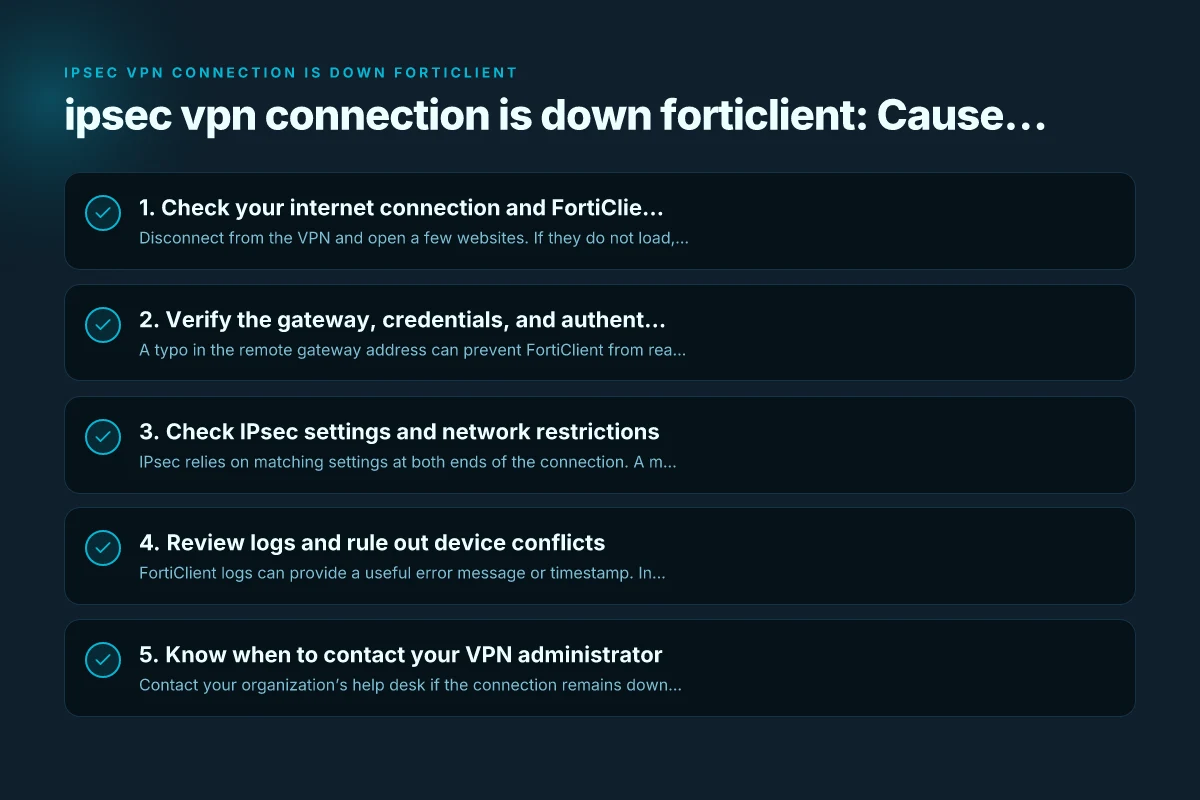
1. Check your internet connection and FortiClient status
Disconnect from the VPN and open a few websites. If they do not load, resolve the underlying internet or Wi-Fi problem before troubleshooting the tunnel. If possible, try another trusted network, such as a mobile hotspot. A connection that works on one network but not another may indicate that a router, captive portal, or network firewall is blocking VPN traffic.
Next, open FortiClient and check the VPN entry you are using. Make sure it is the expected IPsec profile, not an SSL VPN profile with a similar name. Note any error message or status text. It may help identify whether the failure is due to authentication, connection timeout, or configuration.
Also try the basic recovery steps:
- Disconnect and reconnect once.
- Quit and reopen FortiClient.
- Restart the computer if the VPN service appears unresponsive.
- Check whether FortiClient has an available update approved by your organization.
If the VPN worked previously, ask whether anything changed recently: a password reset, software update, new router, travel, or a change to the VPN profile can narrow down the cause. FortiClient IPsec: How to Set Up and Troubleshoot a VPN
2. Verify the gateway, credentials, and authentication
A typo in the remote gateway address can prevent FortiClient from reaching the VPN. Compare the address in the profile with the current details provided by your organization. Do not guess a replacement gateway or copy settings from an unofficial source.
Check your username and password carefully. Some organizations require a specific username format, such as a short account name or email address. If your organization uses multifactor authentication, follow its current sign-in process and approve the prompt promptly. Repeated failed attempts may lock the account, so avoid retrying an uncertain password many times.
Certificates can also affect authentication. If the VPN uses a client certificate, confirm that it has not expired and that the correct certificate is selected. Do not delete certificates or install new ones unless your IT team instructs you to do so.
If you recently changed your password, the VPN may still be using saved credentials. Update the saved login information only through the approved FortiClient profile or your organization’s instructions. If authentication still fails, ask an administrator to confirm that your account is enabled and authorized for IPsec access. VPN Cisco: How Cisco VPN Works and When to Use It
3. Check IPsec settings and network restrictions
IPsec relies on matching settings at both ends of the connection. A mismatch in the profile can stop negotiation even when the gateway is reachable. If you manage the VPN profile, compare its settings against the configuration supplied by your administrator. Otherwise, avoid changing advanced fields yourself and ask IT to verify them.
Common items to confirm include:
- The correct remote gateway and authentication method.
- The expected pre-shared key or certificate, if applicable.
- The correct IKE version and phase 1 and phase 2 parameters.
- The intended user group, address assignment, and split-tunnel settings.
- The current FortiClient version and operating-system compatibility.
Some networks restrict VPN traffic. IPsec commonly uses UDP ports 500 and 4500, and may use the Encapsulating Security Payload (ESP) protocol. A hotel, office, or public Wi-Fi network may block or interfere with this traffic. Testing on another trusted network can help distinguish a local restriction from a FortiClient or gateway problem.
| What you observe | Likely area to investigate |
|---|---|
| VPN fails on every network | Credentials, profile, FortiClient, or VPN gateway |
| VPN works on a hotspot but not on Wi-Fi | Router or network filtering |
| Other users are also disconnected | VPN gateway or shared service issue |
| Authentication fails immediately | Account, password, certificate, or MFA |
| Connection starts but does not complete | IPsec negotiation, network filtering, or gateway settings |
These clues are not definitive, but they help your administrator focus troubleshooting. TunnelBear Extension Edge: How to Install and Use It
IPsec connection symptoms and next steps
| Symptom | Likely area to check | First action | Helpful evidence | Next step |
|---|---|---|---|---|
| No internet access | Local network | Restore normal connectivity | Whether other sites load | Retry the VPN |
| FortiClient is not running | Client status | Open or restart FortiClient | Client status or error | Contact support if it will not open |
| Gateway cannot be reached | Gateway or network | Verify the gateway address | Connection error details | Ask the administrator to confirm the address |
| Login is rejected | Credentials or authentication | Recheck credentials and method | Exact authentication message | Confirm access with the administrator |
| Connection fails after login | IPsec configuration | Compare settings with required values | Client configuration and error | Ask the administrator to review settings |
| Failure occurs only on one network | Network restrictions | Try another permitted network | Whether the VPN works elsewhere | Contact the network administrator |
| Failure began after a device change | Device conflict | Check other VPN or security software | Recent changes and logs | Ask IT before removing or changing tools |
| Cause is unclear | Logs and administrator review | Record the error and connection time | FortiClient logs and troubleshooting steps | Send details to the VPN administrator |
Compiled November 2026; check the provider's site for current details.
4. Review logs and rule out device conflicts
FortiClient logs can provide a useful error message or timestamp. In the application, look for its logging or diagnostic section. The exact labels vary by version and operating system. Record the time of a failed attempt and copy the relevant error text. Share it only through your organization’s approved support channel, and do not post logs publicly if they contain usernames, addresses, or other sensitive information.
A firewall, endpoint security product, or another VPN client may interfere with the connection. Do not disable security software as a routine fix. Instead, ask your IT team whether FortiClient needs an approved exception or whether another VPN client should be closed. If you use a managed device, security policies may also prevent changes to network adapters or VPN services. Where Is My VPN Located? Find Your VPN Server and Virtual Location
Before reinstalling FortiClient, confirm that you have the correct installation package and VPN profile. Reinstallation may remove locally saved settings, and it will not fix a gateway outage, blocked network traffic, or an account problem.
5. Know when to contact your VPN administrator
Contact your organization’s help desk if the connection remains down after the basic checks, if the profile is managed, or if you see an authentication or negotiation error you cannot resolve. Include:
- Your operating system and FortiClient version.
- The exact error message and the time it occurred.
- Whether the issue happens on more than one network.
- Whether coworkers are affected.
- Any recent password, device, network, or software changes.
Ask the administrator to check gateway availability, account permissions, certificate status, authentication logs, and IPsec negotiation logs. If multiple users are affected, the issue is more likely to be on the VPN service side than on your device.
What to try yourself and what to ask the VPN administrator Big IP VPN Download: How to Find and Install a Safe VPN
| Issue | User can check | Administrator may need to verify | Useful details to share | Avoid |
|---|---|---|---|---|
| Internet access | Whether other services work | Network availability, if needed | Network used and connectivity status | Changing VPN settings before internet works |
| FortiClient status | Whether the client opens and reports an error | Client deployment or support requirements | Client status and error text | Ignoring repeated startup failures |
| Gateway address | Whether it matches supplied instructions | Correct gateway for the account | Address entered and connection time | Guessing a replacement gateway |
| Credentials | Whether the username and password are current | Account access or authentication policy | Rejection message, without sharing a password | Sending passwords in a support request |
| Authentication method | Whether the configured method matches instructions | Required authentication settings | Method selected and error text | Trying unapproved authentication changes |
| IPsec configuration | Whether visible settings match instructions | Correct IPsec parameters | Relevant settings and error details | Making undocumented configuration changes |
| Network restrictions | Whether another permitted network behaves differently | Network or firewall restrictions | Networks tested and results | Bypassing workplace security controls |
| Logs and conflicts | Whether other VPN or security tools may be involved | Log interpretation and approved conflict checks | Relevant logs and recent device changes | Removing security software without approval |
Compiled November 2026; check the provider's site for current details.
Recommendation
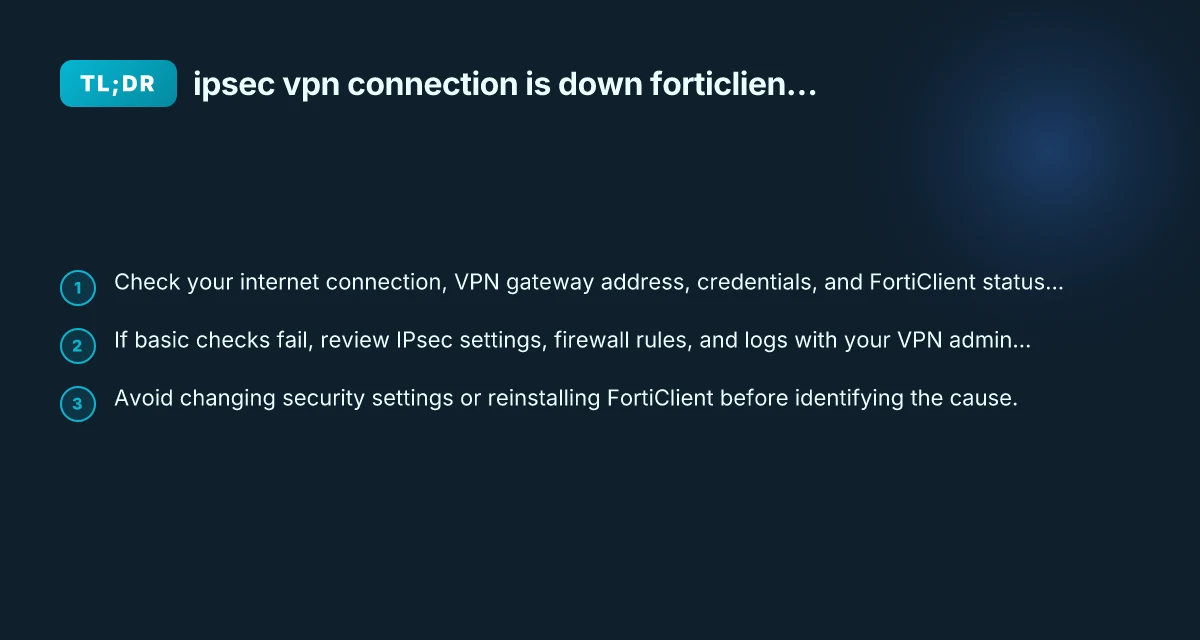
Start with internet access, the correct VPN profile, and valid authentication, then test another trusted network. If those checks do not identify the cause, send the error message and connection details to your VPN administrator rather than changing advanced IPsec or security settings.