VPN FortiGate: How It Works, How to Set It Up, and Which Type to Choose
Learn how FortiGate VPNs work, compare IPsec and SSL VPN, and follow practical setup and security guidance.
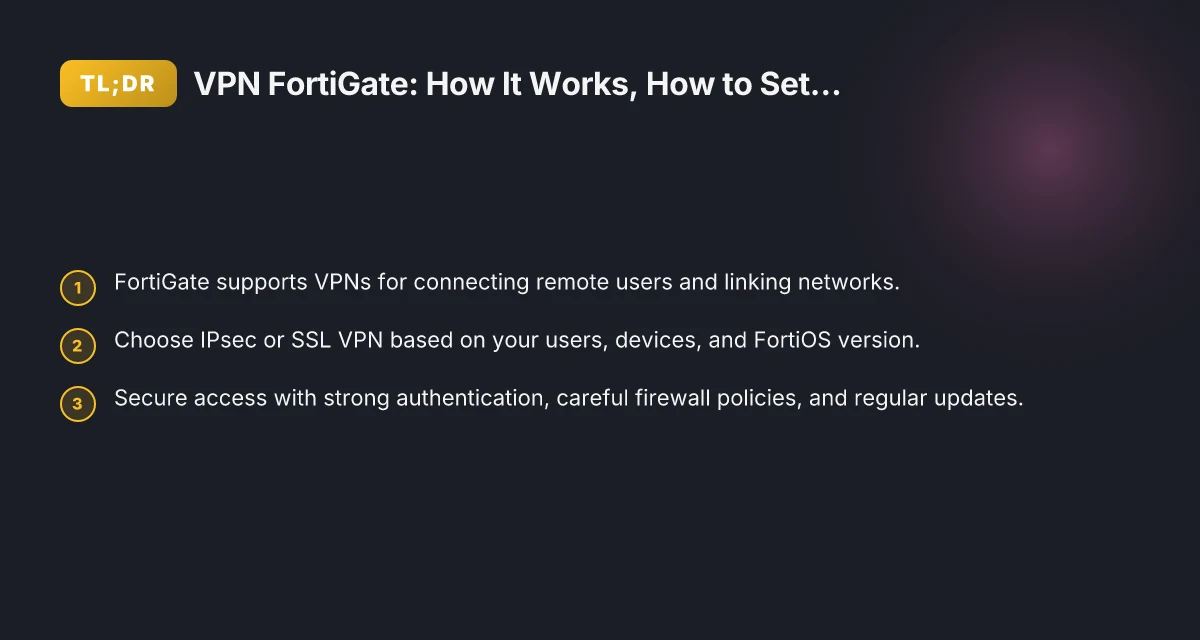
A VPN FortiGate setup uses a Fortinet FortiGate firewall to create encrypted connections between remote users, offices, or cloud networks. The firewall controls VPN traffic and applies security policies to it. For a remote-access VPN, users connect to the company network. For a site-to-site VPN, two or more networks communicate securely over the internet. The right configuration depends on the connection type, FortiOS version, and your organization’s access requirements.
Compare FortiGate VPN types
| Factor | IPsec VPN | SSL VPN |
|---|---|---|
| Typical use | Site-to-site or remote access | Remote access |
| Connection layer | Network layer | TLS-based |
| Client options | FortiClient or compatible IPsec client | FortiClient or browser, depending on setup |
| Site-to-site support | Supported | Generally not used |
| Remote access support | Supported | Supported |
| Network access | Can provide broad network access | Configurable by user or portal |
| Setup considerations | Phase 1 and Phase 2 settings | Portal, authentication, and access settings |
| Best fit | Connecting networks or managed clients | User-friendly remote access |
Compiled November 2026; check the provider's site for current details.
| VPN | Obfuscation | From / month | Plan | Free plan | Refund | Alipay | UnionPay | Crypto | Website opens in China | Trustpilot | |
|---|---|---|---|---|---|---|---|---|---|---|---|
 ZoogVPN | Turn on manually Shadow | $2.49/mo | 27 months: $59.99 | Yes | 7 days | ✓ | ✓ | ✓ | ✓ | Official site blocked; our special link opens (4.4 s) | 4.2/5 (195 reviews) |
 NordVPN | Turn on manually Obfuscated Servers / NordWhisper | $3.49/mo | 27 months: $94.23 | No | 30 days | ? | ✗ | ✓ | ✓ | ✗ Blocked | 4.2/5 (51,628 reviews) |
 ExpressVPN | ✓ On by default all servers | $3.00/mo | 28 months: $84 | No | 30 days | ✗ | ✗ | ✓ | ✗ | ✗ Blocked | 4.4/5 (29,706 reviews) |
 Surfshark | ✓ On by default Camouflage, with OpenVPN | See site | See site | No | 30 days | ✗ | ✗ | ✗ | ✓ | ✗ Blocked | 4.3/5 (31,823 reviews) |
 Proton VPN | Turn on manually Stealth, free plan too | $2.99/mo | 12 months: $35.88 | Yes | 30 days | ✗ | ✗ | ✗ | ✓ | ✗ Blocked | 2.1/5 (1,040 reviews) |
 Astrill VPN | Turn on manually StealthVPN / OpenWeb | $12.50/mo | 24 months: $300 | No | See site | ✗ | ✗ | ✗ | ✓ | ✗ Blocked | 1.3/5 (110 reviews) |
 Private Internet Access | Turn on manually Shadowsocks, OpenVPN only | $2.03/mo | 40 months: $81.2 | No | 30 days | ✗ | ✗ | ✗ | ✗ | ✗ Blocked | 4.2/5 (11,033 reviews) |
 CyberGhost | Turn on manually selected servers | $2.19/mo | 28 months: $61.32 | No | 45 days | ✗ | ✗ | ✗ | ✓ | ✗ Blocked | 4.0/5 (24,178 reviews) |
 PureVPN | Turn on manually switch to OpenVPN | $1.69/mo | 60 months: $101.55 | No | 31 days | ? | ? | ✗ | ✓ | ✗ Blocked | 4.4/5 (17,994 reviews) |
 AdGuard VPN | ✓ On by default TrustTunnel | $2.99/mo | 24 months: $71.76 | Yes | 30 days | ✓ | ✗ | ✓ | ✓ | Official site blocked; our special link opens (3.7 s) | 4.3/5 (290 reviews) |
 Mullvad | Turn on manually QUIC / Shadowsocks / LWO | $5.61/mo | €5/mo | No | 14 days | ✗ | ✗ | ✗ | ✓ | ✗ Blocked | 3.2/5 (192 reviews) |
 Windscribe | Turn on manually Stealth / WStunnel | $5.75/mo | 12 months: $69 | Yes | See site | ✗ | ✗ | ✗ | ✓ | ✗ Blocked | 4.7/5 (13,355 reviews) |
 StrongVPN | Turn on manually Scramble, OpenVPN TCP | See site | See site | No | 30 days | ✓ | ✗ | ✗ | ✗ | ✗ Blocked | 4.4/5 (2,695 reviews) |
 LightXtreme 闪连 | Not listed | $7.08/mo | 12 months: $84.99 | Yes | 30 days | ✓ | ✓ | ✓ | ✓ | ✓ Yes (3.5 s) | No page |
Prices checked 2026-11-10 on each vendor's pricing page (cheapest long plan, USD). Check the vendor's checkout for the final price.
Obfuscation checked 2026-11-14 on each vendor's site and help center: "on by default" = nothing to set; "turn on manually" = switch protocol or mode in settings; "not listed" = the vendor describes no obfuscation.
Payment methods checked 2026-11-10 on each vendor's payment pages: all 14 take cards and PayPal; ✗ = not listed, ? = the vendor's own pages disagree.
China access: whether the official website opens from mainland China networks (tests the website only, not the VPN connection). Last checked 2026-11-18 01:02 Beijing time.
Trustpilot score and review count checked 2026-11-10.
What a FortiGate VPN does
FortiGate VPNs protect data as it travels across untrusted networks. Encryption helps prevent outsiders from reading traffic, while authentication verifies the user or device attempting to connect. The firewall can then allow or block access according to configured policies.
There are two common use cases:
- Remote access: Employees connect from home or while traveling to approved company resources.
- Site-to-site: Firewalls at separate offices, data centers, or cloud environments connect their networks.
A VPN does not automatically make every internal system safe to access. Administrators still need to define which users can reach which services and monitor activity.
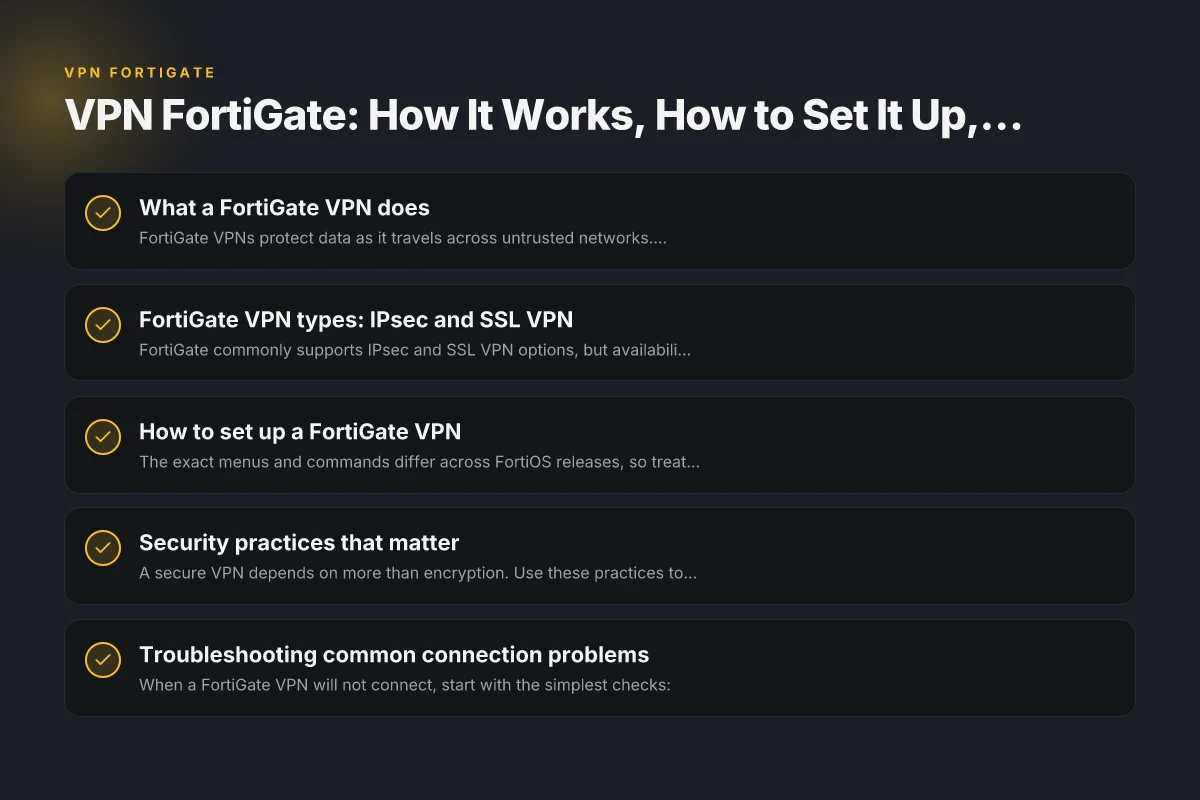
FortiGate VPN types: IPsec and SSL VPN
FortiGate commonly supports IPsec and SSL VPN options, but availability and recommended use can vary by FortiOS release, device model, and licensing or configuration details. Check current Fortinet documentation for the specific version in use before deployment. Com.NordVPN.Android: What It Is and How to Install It Safely
| VPN type | Often used for | Considerations |
|---|---|---|
| IPsec VPN | Site-to-site links and remote access | Requires compatible client and network settings; can work well for managed devices |
| SSL VPN | Remote-user access through a VPN client or supported browser-based workflow | Features and availability vary by FortiOS version; review Fortinet’s current guidance |
For an office-to-office connection, IPsec is a common choice. For individual users, the best option depends on the FortiOS version, client support, device management, and security requirements. Do not choose based only on familiarity: confirm that the selected method is supported and appropriate for your environment.
Choose a VPN type by requirement
| Requirement | IPsec VPN | SSL VPN | Decision cue |
|---|---|---|---|
| Connect two office networks | Supported | Not the usual choice | Prefer IPsec |
| Support remote employees | Supported | Supported | Either may fit |
| Use a browser-based portal | Not typical | Supported when configured | Prefer SSL VPN |
| Provide full network-level access | Supported | Possible with suitable configuration | Match access needs |
| Use managed client devices | Supported | Supported | Either may fit |
| Keep access limited to specific resources | Supported | Supported | Apply least privilege |
| Integrate with existing VPN clients | Depends on client compatibility | Depends on client compatibility | Check device support |
| Minimize configuration complexity | Depends on network design | Depends on portal and policy design | Compare deployment needs |
Compiled November 2026; check the provider's site for current details.
How to set up a FortiGate VPN
The exact menus and commands differ across FortiOS releases, so treat this as a planning checklist rather than a version-specific configuration recipe. Certificate Validation Failure Cisco VPN: Causes and Fixes
1. Define the access requirements
Decide who needs access and what they need to reach. Identify the user groups, remote devices, internal subnets, and services involved. Limit access to necessary resources instead of exposing the entire network by default.
2. Choose the VPN design
Select remote access or site-to-site, then choose an appropriate VPN method. For site-to-site connections, confirm that both endpoints support compatible settings. For remote users, check client compatibility and how devices will be managed.
3. Configure authentication and address assignment
Create or select the user groups and authentication method. Use unique accounts, strong passwords, and multifactor authentication where supported. For remote access, plan how VPN clients will receive addresses and avoid conflicts with existing network ranges.
4. Set firewall policies and routes
A VPN tunnel can be established while traffic still fails because policies or routing are incomplete. Configure the necessary firewall rules and routes, and restrict access to approved destinations and ports. For site-to-site VPNs, check both ends of the connection. Forticlientvpnonlineinstaller: What It Is and How to Install FortiClient VPN
5. Test and document
Test with an authorized account and verify access to each required service. Also test that users cannot reach resources outside their permissions. Record the configuration, recovery steps, and responsible contacts so the VPN can be maintained safely.
Security practices that matter
A secure VPN depends on more than encryption. Use these practices to reduce risk:
- Require multifactor authentication for remote users where available.
- Use individual accounts rather than shared credentials.
- Apply least-privilege firewall policies and restrict access by user group.
- Keep FortiGate firmware and VPN clients updated according to a tested maintenance plan.
- Disable unused accounts, VPN methods, and services.
- Monitor authentication events, connection logs, and unusual access patterns.
- Protect administrative access separately, and avoid exposing management interfaces to the public internet.
- Review VPN access regularly, especially when staff roles change or accounts are removed.
Also consider endpoint security. A VPN encrypts traffic between the client and the firewall, but it does not by itself protect a compromised laptop or prevent unsafe behavior on the device.
Troubleshooting common connection problems
When a FortiGate VPN will not connect, start with the simplest checks: Best Free VPN Extension for Microsoft Edge: What to Know Before You Install
- Authentication fails: Confirm the username, account status, group membership, and multifactor authentication process.
- The client cannot reach the gateway: Check the public address, DNS, internet connection, and any upstream firewall rules.
- The tunnel connects but resources do not load: Review firewall policies, routes, address ranges, and DNS settings.
- Only some applications fail: Check whether the required ports and protocols are permitted and whether application settings depend on internal DNS.
- A site-to-site tunnel is unstable: Compare the settings at both endpoints and review logs for negotiation errors or connectivity changes.
Use FortiGate logs and client-side messages to narrow down the cause. Avoid changing several settings at once. Make one controlled change, test, and document the result. For complex or production-critical issues, consult Fortinet documentation or a qualified network administrator.
Troubleshoot FortiGate VPN connection problems
| Symptom | Check first | IPsec-specific checks | SSL VPN-specific checks | Next step |
|---|---|---|---|---|
| Cannot connect | Internet and FortiGate reachability | Gateway address | Server address and port | Confirm endpoint details |
| Authentication fails | Username and credentials | User or group configuration | User, group, and portal mapping | Verify account status |
| Connection times out | Firewall and routing | UDP reachability and peer settings | TLS reachability and certificate | Review network path |
| Tunnel will not establish | Client and FortiGate settings | Phase 1 and Phase 2 match | Portal and authentication settings | Compare configurations |
| Connects but no access | Policies and routes | Tunnel routes and firewall policy | Portal access and firewall policy | Check permitted resources |
| Name resolution fails | DNS settings | DNS delivered through tunnel | DNS delivered to client | Test with an internal address |
| Disconnects repeatedly | Client logs and network stability | Rekey and peer settings | Session and client settings | Review logs on both ends |
Compiled November 2026; check the provider's site for current details.
Recommendation
Use a FortiGate VPN when you need controlled, encrypted access between remote users or separate networks. Choose IPsec or SSL VPN only after checking current FortiOS support and matching the option to your use case. Start with least-privilege access, strong authentication, and a documented test plan, then maintain the setup with regular updates and access reviews. NordVPN in China: Does It Work and How to Prepare